
Notifications 12
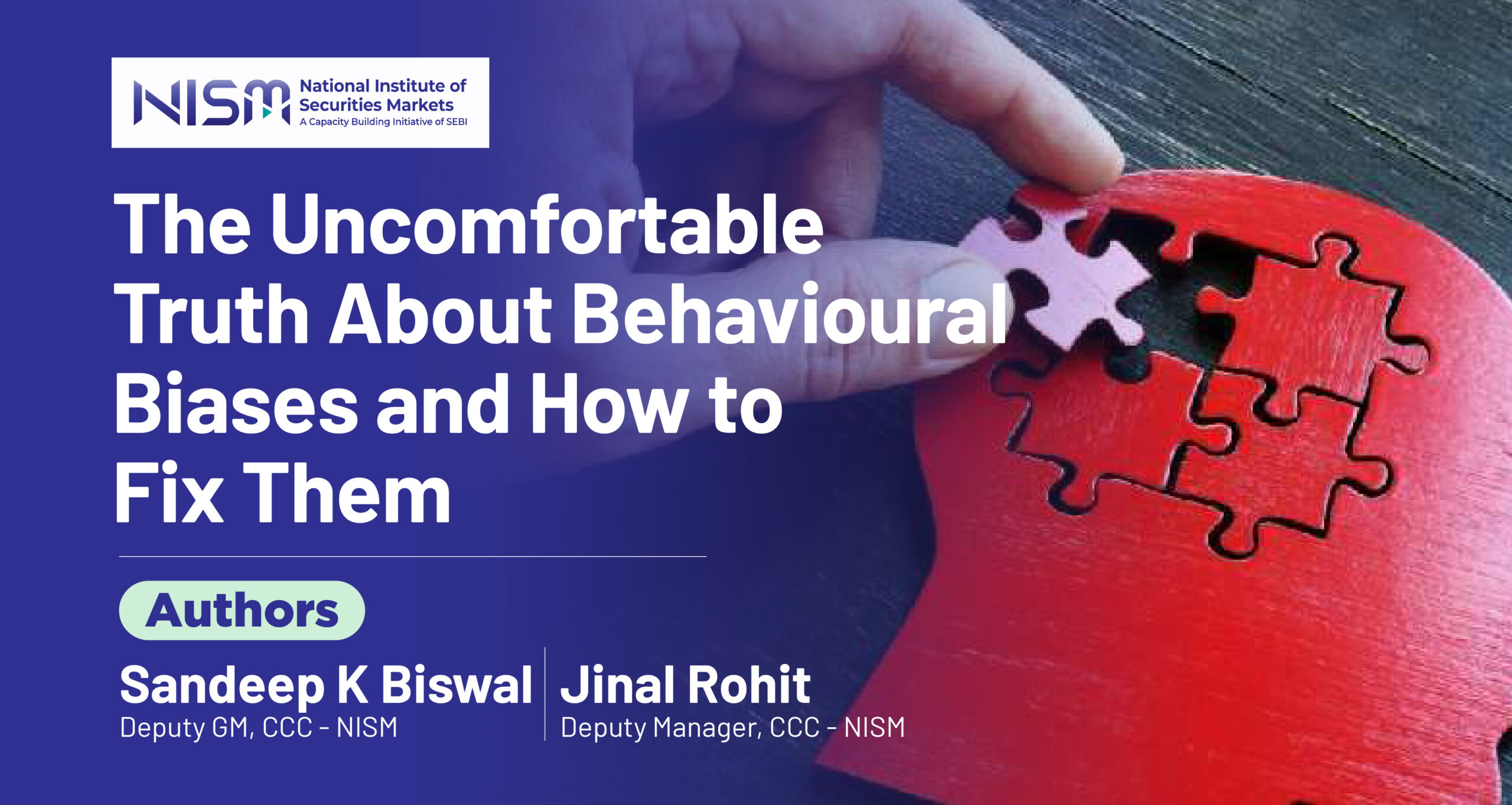
The uncomfortable truth about behavioural biases and how to fix them.
We have all experienced it at some point. We invested in a stock because everyone around us was investing in it. We were convinced it would be the next big thing, a multi-bagger. Then the stock price kept falling. Instead of selling it and cutting our losses, we held on. We hoped and prayed that it would bounce back. Instead, it kept falling. Frustrated, we finally decided to sell the stock. The stock price started rising a week later.
Here’s the uncomfortable truth about what we have experienced: it’s not lack of intelligence or financial knowledge. It is something far more subtle: our behavioural biases. Our brain is wired to take mental shortcuts that overpower logic and rationality. It is not difficult to understand why it happens. After all, the human brain has evolved for survival. It’s those deep-rooted survival instincts that push us to follow the crowd for safety.
But the good news is we can recognise these behavioural biases and learn to overcome them.
Traditionally, it is assumed that individuals are rational, which means they make decisions purely on logic and self-interest. This is based on the principles of Rational Choice Theory, which states that individuals will always act in self-interest to maximise their own benefit. And collectively, this leads to the overall good of society.
Later on, economists like Amos Tversky, Daniel Kahneman, and Richard Thaler found many limitations of the assumption that individuals are rational. According to them, individuals are highly emotional and can be easily influenced by external factors. So individuals can not always make the best decisions. This led to a new branch within economics known as Behavioural Economics. It explores how psychological factors affect our economic decision-making and lead us to make suboptimal choices.
Behavioural finance is a sub-field of behavioural economics. It studies how psychological factors, such as biases, influence our financial decisions. It challenges the idea that investors always act in their self-interest. Instead, it recognises that individuals are emotional, irrational, and heavily influenced by others.
One of the key aspects of behavioural finance is the study of behavioural biases. In this section, we will talk about three core biases that quietly influence our financial decisions.
Overconfidence Bias
We almost always fail to gauge our own abilities accurately. This is known as the Dunning-Kruger effect. Two renowned psychologists, David Dunning and Justin Kruger, conducted a study by asking Cornell University students to predict their test scores. When the actual results were declared, they found that those students who ranked in the bottom 25% of their test scores had predicted themselves to be at the top of the class. Conversely, students in the top 25% had predicted their test scores to be lower than their actual score.
In investing, this particular phenomenon is known as overconfidence bias. Traders and investors overestimate their ability by quite a bit. In fact, a recent SEBI statistic stated that 9 out of 10 individual traders (in the F&O segment) lose money. Yet, people continue to trade because they feel like they have a chance at being that 1. It’s our overconfidence bias that gets us to take all sorts of risks. Another common example of this bias is when about 80% of drivers rate themselves as above average, which is mathematically impossible.
Simply knowing about this bias can help us minimise its influence on our decisions. We can actively seek alternative perspectives, analyse worst-case scenarios, and be open to feedback, which is easier said than done.
Loss Aversion Bias
We hate losing. We really, really hate losing money. In fact, behavioural economists have found that the pain of losing money is twice as intense as the happiness of winning it. You see, we are biologically wired to avoid the pain. So, we actively try to prevent our losses, so much so that we do not mind taking extra risk for it. This is known as loss aversion bias.
An example of this bias is when we are offered a choice between a guaranteed win of ₹500 and a 50% chance to win ₹1000; we would always take the ₹500. But if we are offered a choice between a guaranteed loss of ₹500 and a 50% chance to lose ₹1000, we would choose the latter. We can clearly see that by choosing the latter, we may end up losing ₹1000, but we are willing to take the risk. Again, we do this because we cannot stand the idea of losing money.
Another classic example of loss aversion bias at work is when we hold on to a losing stock, hoping it would recover, rather than accepting our mistake and booking the loss. Conversely, we sell the stock whose price has gone up in fear that our profits may disappear. Loss aversion bias also forces many of us to avoid investing in the stock market and keep our savings in the bank, in the process losing purchasing power because of inflation.
Sure, we want to avoid losses. At the same time, we must also realise that losses are inevitable. We can learn a great deal from our losses if we analyse them strategically without being emotional. Focus on the long term, learn to automate investments, spread the risk, and make decisions based on data and research rather than emotions.
Herd Mentality Bias
It’s our primitive survival instinct that tells us to follow the crowd. Because standing alone, while others are running away, can be dangerous- what if there is a predator? We have all seen this on National Geographic. A large herd of wildebeests running away from a chasing lion pride. It’s a visual masterclass. We all appreciate how flocking together works in the wildebeest’s favour. This behaviour is prevalent in humans too; after all, we are social animals.
Wilfred Trotter, a social psychologist, has compared human societies to animal packs. He said he noticed this during World War I, when nations used propaganda to manage mass populations like livestock. In his famous work, Instincts of the Herd in Peace and War, he stated that our mind rarely questions the rules handed down by the group we belong to. Instead, we make up logical reasons to justify what the group wants.
Call it social pressure, fear of missing out, or safety in numbers, herd mentality bias guides much of our behaviour, particularly in the stock market. And the key reason is social media and its role in the information cascade. Influencers, guided by personal profit, deliberately share information that their followers use to make investment decisions. And as more and more followers join in, the cascade effect multiplies.
Okay, so following the herd is a problem. But the psychological pain of going against the herd is very intense too. So how can we avoid the problems of herd mentality bias? Let’s start by remembering what Warren Buffett famously said: “Be fearful when others are greedy and greedy when others are fearful.” This requires that we focus only on the things we can control, treat our mistakes as useful lessons, trust our ability, and stay the course when others are leaving.
Why this matters in India
Let us see exactly how these biases are playing out in India today. In 2025, SEBI surveyed over 50 thousand households across the country to understand how these households engage with the securities market and what influences their financial decisions. This is one of the most comprehensive reports on investor behaviour in India. Some of the key findings from this report directly relate to what we are discussing in this blog.
50% of existing investors were classified as having low knowledge of the securities markets, including basic concepts such as inflation. (Overconfidence Bias)
53% of affluent investors have high to moderate knowledge, meaning almost 50% are making investment decisions without adequate understanding. (Overconfidence Bias)
34% of non-investors consider fear of losing money to be one of their top reasons for not investing in the stock market. (Loss Aversion Bias)
80% of Indian households consider capital preservation to be their top priority over growth. (Loss Aversion Bias)
71% of existing stock investors and 74 % of existing mutual fund investors identify themselves as low-risk tolerant. (Loss Aversion Bias)
62% of investors make their investment decisions based on recommendations from social media influencers. (Herd Mentality Bias)
63% of investors in rural areas and 52% in metro cities rely on friends and family to make their investment decisions. (Herd Mentality Bias)
So behavioural biases exist. They are like built-in features of our human brain. They will continue to influence our decision-making process. We can not simply delete them. As discussed, being aware of these biases and understanding why we make the decisions that we make is very important. And that is exactly what this NISM eLearning module “Behavioural Finance: Psychology of Financial Decisions” aims to do.
NISM eLearning Module on Behavioural Finance
The “Behavioural Finance: Psychology of Financial Decisions” Skill Development Module (SDM) offered by NISM, comprehensively covers different aspects of behavioural finance, including:
The psychology of irrational behaviour and the role of emotions.
Origins of behavioural finance and Nudge theory.
A deep dive into various types of behavioural biases.
Understanding market anomalies and asset bubbles.
Examining individual and institutional investor patterns.
Practical strategies to counter bias-driven decisions.
The video-based learning content is around 2 hours long and offered at a fee of just ₹500 plus taxes. When you complete the course, you receive a downloadable and shareable certificate from NISM.
To enrol or learn more, visit the NISM website or contact the eLearning helpdesk.
Authors: Sandeep K Biswal & Jinal Rohit
Last Updated on: September 3, 2026 The minds inside a derivatives account SEBI’s Department of Economic and Policy Analysis has…

A Yen Rescue Dressed in Euros Washington’s intervention was ingenious in its plumbing and silent on the flows that matter…

The Closing Auction Needs Attendance, Not a Rethink A well-attended closing auction benefits investors by lowering trading costs, providing a…
© 2026 National Institute of Securities Markets (NISM). All rights reserved.
