
Notifications 12
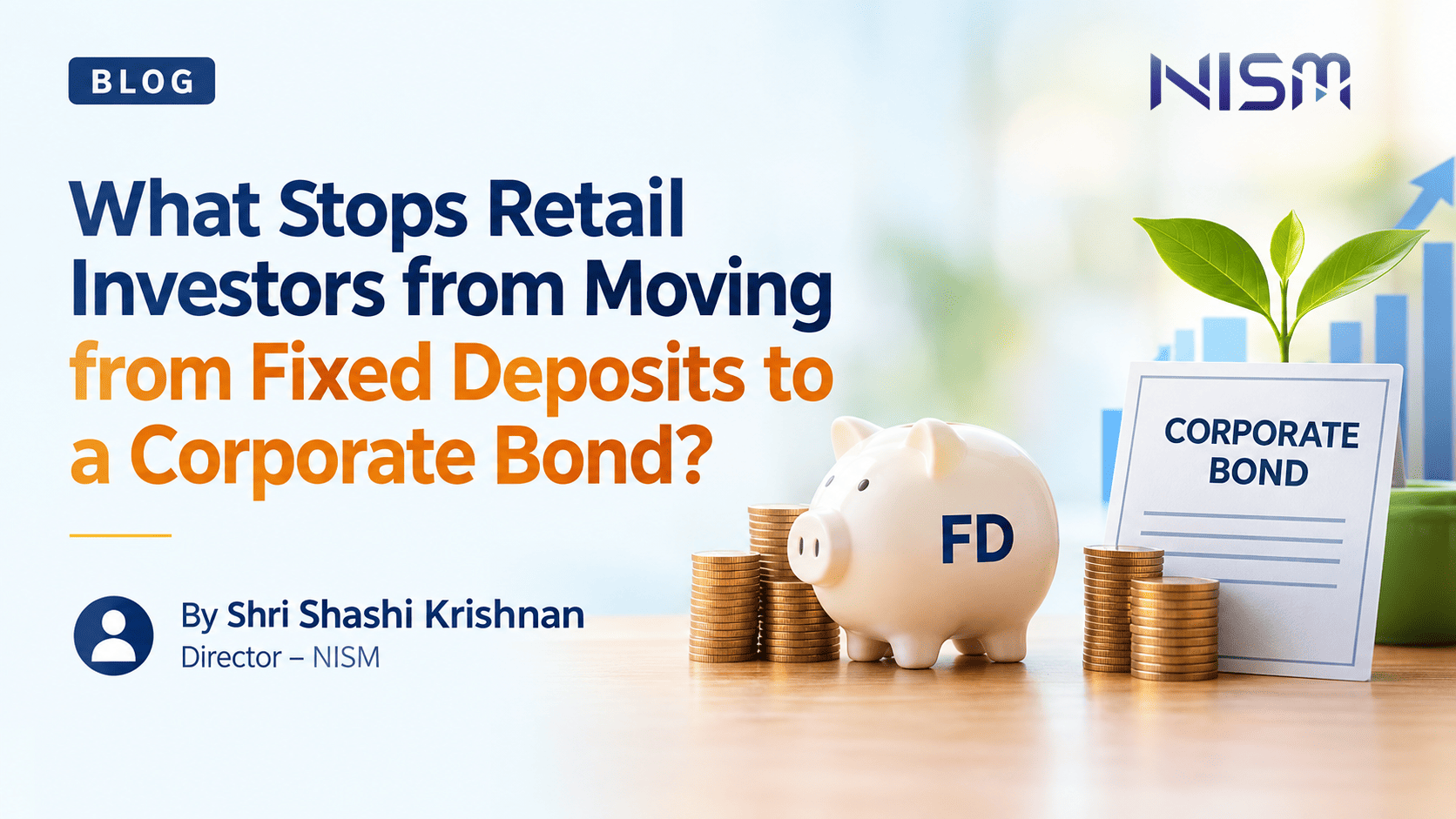
The Indian corporate bond market has grown from ₹17.5 lakh crore at the end of FY15 to over ₹60 lakh crore today. The minimum face value of a bond has come down to ₹10, 000. Online bond platforms are now regulated. However, retail investors hold just ₹1.2 lakh crore of corporate bonds compared to ₹152 lakh crore of fixed deposits. Has the time come for retail investors to reassess their debt asset allocation?
While deciding on asset allocation, investors look at three things – potential returns, risks associated with the investment and liquidity of the asset class. Doubtless, corporate bonds tend to deliver better returns than fixed deposits. ₹1,00,000 invested in a three-year fixed deposit, which yields 6.75% today, will grow to ₹1,22,239. The same money invested in a AAA corporate bond at today’s yield of 7.60% will grow to ₹1,24,566, ₹2,327 more over three years. An investment in a BBB bond at today’s yield of 13% will grow to ₹1,44,290, which is ₹22,647 more than what a fixed deposit gives. Even the safest bonds give better returns than deposits. Returns from lower-rated bonds, as expected, are substantially ahead of fixed deposit returns.
The extra return that bonds deliver comes with extra risk. How then should investors evaluate this extra risk? While bonds do carry the risk of non-payment of principal and interest, it should not be the reason to stay away from investing in them. The CRISIL Default and Rating Transitions Study 2026 suggests that the probability that an entity rated AAA will default within 3 years is 0%. The probability that an entity rated BBB will default within 3 years is just 1.97%. Over a shorter 1-year horizon, the probability that the BBB-rated bond will default is much lower at 0.43%.

Another possibility is a bond getting downgraded. Any downgrade impacts the market price of bonds. This matters only if the investor needs to sell the bond before maturity. If an investor intends to hold the bond to maturity, she need not be too concerned, as the issuer keeps paying interest and she will get the principal on maturity. CRISIL data indicates that the probability of a AAA bond being downgraded to a rating below AAA is very low. The probability of a BBB bond being downgraded to a lower rating is also less than 5%.
Liquidity is another issue retail investors are worried about. A deposit has no market price, and it can be broken on any working day, though early withdrawal does carry the risk of a reduced interest rate. Liquidity for corporate bonds, on the other hand, varies widely. Highly rated bonds are liquid, but for lower-rated bonds, liquidity is often a problem. This has been partially addressed by the 29 online bond platforms that now operate in the market. These platforms have made buying a bond as easy as opening a deposit, though selling a bond can still pose a problem as markets are thin. As more retail investors start participating in the bond market through these platforms, the secondary market should deepen.
What a fixed deposit offers retail investors is not a superior rate of return but the certainty of exit. Money that may be needed at short notice will, obviously, find its way into deposits. However, investment-grade bonds held to maturity are now an alternative for retail investors, especially for their long-term financial goals. Better returns, not too high risks, and improving liquidity make this an attractive asset to own.
Author: Shri Shashi Krishnan, Director – NISM
The Indian corporate bond market has grown from ₹17.5 lakh crore at the end of FY15 to over ₹60 lakh…

Last Updated on: September 3, 2026 The minds inside a derivatives account SEBI’s Department of Economic and Policy Analysis has…

A Yen Rescue Dressed in Euros Washington’s intervention was ingenious in its plumbing and silent on the flows that matter…
© 2026 National Institute of Securities Markets (NISM). All rights reserved.
