
(NISM)

The National Institute of Securities Markets (NISM) is a public trust established in 2006 by the Securities and Exchange Board of India (SEBI), the regulator of the securities markets in India. The institute carries out a wide range of capacity building activities at various levels aimed at enhancing the quality standards in securities markets.

India’s Financial Markets Must Evolve with Retail Participation Surge

India’s financial markets today reflect the energy of a nation on the move. Each day, over eight crore individual investors log into trading apps, browse through market dashboards, and partake in the story of India’s growth. The number of demat accounts has surpassed 15 crores, nearly doubling in the last four years, a milestone that positions India among the world’s most retail- active markets.

This surge in participation is a remarkable achievement. It demonstrates public confidence in market institutions, seamless digital access, and forward-looking regulation. It also signifies a profound cultural shift, from physical savings to financial ownership. However, with this scale and speed of inclusion, markets are beginning to face new forms of complexity that require continuously evolving strategies safeguards.

Complexity and Opportunity In Derivatives

The derivatives segment clearly demonstrates this transformation. In just five years, equity- index options trading has grown more than eight times, making India one of the largest derivatives markets globally by notional value. Technology has allowed trades to be squared off in milliseconds, and the involvement of younger, tech-savvy investors has made derivatives a mainstream part of the financial landscape.

However, this velocity also introduces new dynamics. On certain trading days, especially near expiry, deep out-of-the-money option contracts have shown nearly vertical price jumps, sometimes increasing by several multiples within minutes. While these instances are rare, they demonstrate how concentrated order flows and algorithmic trading can intensify movements in strikes that are far out of the money with low liquidity. Although these episodes are brief, they underscore the need for closer monitoring in a market where scale amplifies every movement.

Volatility and Global Linkages

Periods of increased volatility often align with foreign portfolio investor (FPI) outflows as global funds rebalance their holdings. In 2024 alone, India experienced net FPI withdrawals exceeding Rs 1.2 lakh crore amid global uncertainty, even as domestic inflows from retail and mutual funds helped maintain stability. Retail investors, now representing nearly 38 per cent of cash-market activity, have become the stabilising counterbalance to global fund flows.

That confidence, however, depends on trust that market prices reflect real demand and supply rather than distortions. Maintaining that trust is not about enforcement; it is about consistency, making sure markets stay fair, efficient, and trusted.

From Regulation to Anticipation

India’s regulatory framework has consistently shown foresight. Features like dynamic price bands, real-time risk management, and cross-market surveillance have helped ensure that, despite global challenges, our markets keep running smoothly. The next step is proactive supervision, identifying emerging structural risks before they affect market participants.

Global experience shows that successful derivatives markets are not those with unrestricted access but those with smart safeguards. The United States responded to its rise in zero-day-to- expiry (0DTE) options by enhancing algorithmic monitoring and margin sensitivity rather than imposing restrictions, thereby allowing innovation to continue with robust risk controls. Following its KOSPI-200 incident, South Korea adjusted its market design by tightening strike ranges, increasing margins for out-of-the-money contracts, and establishing a dedicated derivatives-risk monitoring team, thereby restoring stability without limiting liquidity.

Taken together, these models suggest a practical framework for India, one that integrates data- driven, real-time surveillance with adaptable strike rationalisation, tiered margining, and participant-level suitability standards. This approach would enhance transparency, safeguard investors, and boost market confidence, ensuring India’s derivatives ecosystem remains both innovative and institutionally robust as it develops into a global benchmark.

Empowering Investors for The Long Term

India’s new investors are digital-native and aspiring. A generation ago, only a few million individuals participated in stock- market trading; today, tens of millions do so every day. As participation grows, financial literacy and risk awareness must grow too. Focused investor- education modules on derivatives, position management, and volatility can help retail investors better navigate modern markets responsibly.

The Competitive Edge

India’s journey toward a USD 10 trillion economy depends on how effectively its markets convert household savings into productive investments. Improved supervision, increased transparency, and shared accountability among the players in the market ecosystem will ensure that the growing base of trading activity continues to serve the broader goal of nation-building. Safeguarding investor interests is not just about caution, it is a pledge to progress. As India’s markets expand and become more vibrant, trust and transparency will remain their most valuable assets. Protecting that trust is what will support India’s rise, ensuring growth, innovation, and integrity advance together toward a resilient and inclusive financial future.

Article originally published in Business World.
Author: Mr. Venkatachalam Shunmugam, partner, MCQube

Your retirement kitty – How much is enough?

With a host of opinions and views floating around, it is important to make your own estimate

Context

Nowadays, you get a lot of inputs through internet, which is beneficial for you. Social media also gives a lot of inputs, but it is not regulated by any financial market regulator. There is a trend on social media, by a section of financial planners or advisors, of putting forth an amplified number on your required retirement corpus. The logic given there may be correct: increased cost of living in today’s world, your lifestyle, inflation in future reducing the purchasing power of your money, etc. However, the inherent message in those social media posts, though not explicit, is that you require “so much” of money to retire, hence you “come to me” for advice and I will help you create that corpus.

Taking advice from a professional financial planner is always desirable. However, the inducement to do so should not be due to an amplified number propagated on social media to communicate an element of fear. More money you have the merrier, but the estimate has to be in tune with your income and expense level. In today’s article, we will discuss the perspective to look at the requisite retirement kitty.

Estimation of expenses

While it is true that people’s lifestyle expenses have moved up and inflation eats into your kitty, it is about your own lifestyle and expenses, which is unique to you. To each his / her own. Even in today’s world of increased expenses, some families manage their monthly regular expenses at Rs 50 thousand, whereas some families find it difficult at Rs 2 lakhs. Some families have the burden of EMIs, while some families are free on that aspect. Hence it is not correct to propagate one number as the required retirement kitty.

This is a function of your current expenses, your estimate of expenses post retirement and inflation for the remaining years till retirement. It is a common perception that after retirement expenses would move up – apart from inflation – due to medical expenses. However, certain lifestyle expenses cool down after retirement. Today you may desire a fancy car or a fancy phone. With maturity, just a car to travel or a phone to talk would suffice. You may like to visit clubs or eat out today, but in your golden years you would become more sedate. You may have EMIs today, but that will be repaid in due course. Let us take an example. Your current expenses – the usual, regular expenses and not the EMIs or sudden expenses – are Rs 50,000 per month. Let us assume inflation at 5 percent per year. If you have 10 years to go for retirement, due to inflation over 10 years, it becomes Rs 81,445 per month. If you have 20 years to go for retirement, it becomes Rs 1,32,665 per month due to inflation. If your expenses are Rs 2 lakh per month, on the same assumptions, it becomes Rs 3,25,779 after 10 years and Rs 5,30,660 after 20 years.

You have to break down your expenses in terms of components and estimate which are the heads that would remain similar 10 or 20 years down the line, apart from inflation, which ones may move up (like medical) and which ones may come down (like eating out). On the estimated expenses, you inflate it for the number of years to retirement.

Years to Retirement30252015105
Expenses at current price levels (Rs / month)50,00050,00050,00050,00050,00050,000
Assumed Inflation / year5%5%5%5%5%5%
Expenses post retirement (Rs / month)2,16,0971,69,3181,32,6651,03,94681,44563,814
Years to Retirement30252015105
Expenses at current price levels (Rs / month)2,00,0002,00,0002,00,0002,00,0002,00,0002,00,000
Assumed Inflation / year5%5%5%5%5%5%
Expenses post retirement (Rs / month)8,64,3886,77,2715,30,6604,15,7863,25,7792,55,256

Estimation of corpus required

This is a function of multiple variables and assumptions. This is best done by a professional financial planner or adviser as per your requirements. Here we will give an outline so that you get an idea.

You have arrived at an estimate of the expenses per month post retirement. Then the variables are number of years left i.e. your life span, where you would invest your corpus, how much your portfolio would yield, and inflation. For the sake of illustration, let us say you would retire at age 60 and will live till 80 i.e. 20 years to go after retirement. The investment of your corpus for those 20 years would yield a return of 10 percent per year. Inflation is assumed at 5 percent per year. As per formula, net of inflation, your kitty will earn 4.76 percent per year. Your expenses per month, at that stage of life, are Rs 3 lakh per month. You do not want to leave any legacy out of this amount i.e. it may become nil at the end of those 20 years.

Estimation of corpus is, the amount that would give you Rs 3 lakh per month, for 20 years, when the amount invested earns 4.76 percent per year. Under the assumptions, that quantum of money is Rs 4.8 crore. For a requirement of Rs 1 lakh per month during retired life, the amount is Rs 1.6 crore and for Rs 5 lakh per month, it is Rs 8 crore.

The required kitty

Required amount per month (Rs)1,00,0002,00,0003,00,0004,00,0005,00,000
Required corpus under the assumptions (Rs)1,59,90,270
i.e. Rs 1.6 cr
3,19,80,539
i.e. Rs 3.2 cr
4,79,70,809
i.e. Rs 4.8 cr
6,39,61,078
i.e. Rs 6.4 cr
7,99,51,348
i.e. Rs 8 cr

Conclusion

Taking inputs from your environment is good, it broadens your horizon and gives you perspectives. However, you have to figure out what works for you. Otherwise, you would get lost in the multiplicity of views and opinions. To use an analogy, if you want to loose weight, you will get a plethora of advices and videos on social media. Those may be correct in their own way. Somebody would advice running, somebody would advice walking or dieting or something else. May be they got their results that way. However, you have to figure our what suits your conditions. Similarly, the expenses you incur currently and expect to incur in your golden years, is unique to you. There is no need to get swayed by opinions.

Article originally published in the Outlook Money.

Author: Mr. Joydeep Sen, Corporate Trainer, Columnist

Investments in Mutual Funds the other perspective

When we think of investments in Mutual Funds, we think of investments in schemes i.e. products offered by Mutual Funds. But, there is another way to play this buoyant segment. And that is, equity stocks of listed Asset Management Companies. As the industry grows along with the growth of investors coming into the fold and the products they offer, the stocks also would grow. Let us look at the growth of the sector and the factors contributing to it.

The amount of money managed by the MF AMC industry, referred to as Assets Under Management (AUM) stood at Rs 67.4 lakh crore as on March 2025 and currently it is nudging Rs 80 lakh crore as on October 2025. As per projections by Crisil, AUM would touch Rs 150 lakh crore by March 2030. For a perspective, MF AUM to GDP ratio stood at 11.1 percent as on March 2020. As on March 2025, this pushed up to 19.9% of GDP. Global average of this metric is 64 percent and in the USA is at 124 percent. The fact that it is at 19.9 percent shows the scope for growth. What would lead to this growth? It can be bifurcated into two categories: macro factors and industry-specific factors. We start with the macro factors.

India is growing, and will remain growing, at the fastest pace among major economies of the world. In the first half of this financial year, April to September 2025, our GDP has grown at 8 percent. That apart, the trend growth rate i.e. sustainable growth rate as per economists, is in the range of 6.5 to 7 percent. India has the highest working age population in the world, which is driving earnings, savings, consumption and investments in financial products. Our gross domestic savings rate, at 29.2 percent, is a shade higher than the global average of 28.2 percent. Along with growth of the economy, per capita income and disposable income are growing as well. The increase in disposable income can fuel growth in various investment assets, including mutual funds. With increasing financialization of savings i.e. from land / building / property to deposits / stocks / bonds / mutual funds, the share of the pie is going to increase. As per RBI data, share of Mutual Funds in the stock of financial assets of households has increased from 8 percent in 2021-22 to 11 percent in 2023-24. The number of demat accounts in India, which was 5.5 crores as on March 2021 and 15.1 crores as on March 2024, has now touched 21 crores. This has led to more investors coming into the fold of Mutual Funds; the industry specific factors are discussed below.

Number of investor folios (investor accounts), as per AMFI, has moved up to 25.6 crores as on October 2025. As on March 2020, number of investor folios were 8.9 crores. There are overlaps in folios i.e. one investor can have multiple accounts in multiple AMCs. Number of unique investors, identified as per PAN number, was 5.3 crore as on March 2025, as per AMFI. This also shows the scope for growth: in a country with a population of 145 crore with wide use of digital means and spread of banking, this should grow exponentially.

Systematic Investment Plan (SIP) has been a pillar of inflows for the industry, even in periods when inflows through the usual means of lump-sum subscription have waned. SIP AUM stood at Rs 13.4 lakh crores as on March 2025. As per Crisil projection, it would be Rs 41 to 44 lakh crores by March 2030. Investments through systematic investment plans have become a popular form of investing in mutual funds as they offer customers the opportunity to invest smaller amounts over longer periods and help mitigate the risk of market timing. Popularity of equity funds, rising participation of investors, recent investor education initiatives, and apparent benefits of SIPs to households that traditionally did not invest in mutual funds, indicate that growth in inflows from SIPs is expected to accelerate. Investor profile is now skewed towards individuals. As on March 2020, 52.4 percent of investors in the MF industry were individuals. As on March 2025, it increased to 60.6 percent.

The industry is witnessing a notable shift, with smaller cities, referred to as Beyond 30 (B-30) cities, emerging as significant growth drivers, alongside the established Top 30 (T-30) cities. Coming to processes in the industry, integration of technology has reduced processing times, streamlining tasks that once required days, weeks, or multiple in-person visits, into mere seconds, accessible through a smartphone.

Majority of assets in the industry are in equity, which get valued at market prices for NAV. If we take the growth in equity as the nominal GDP growth rate, it is expected to grow at low double digit, plus new investors coming into the fold. There are currently 6 listed Mutual Funds: HDFC AMC and Nippon AMC in mid-cap category and Birla AMC, UTI AMC, Canara Robeco AMC and Shriram AMC in small-cap category. There are two biggies in the pipeline.

The initial public offer (IPO) of ICICI Prudential AMC is from 12 to 16 December 2025, in the price band of Rs 2,061 to Rs 2,165. This is an Offer for Sale (OFS) from UK based Prudential Corporation, offloading 9.9 percent of their stake of 49 percent, to the public. Reportedly, SBI MF is in the offing for their IPO, but it is still about a year away. The new offerings would increase the listed space for investors in stocks of MFs, apart from their products.

Article originally published in the Outlook Money.

Author:

Mr. Joydeep Sen, Corporate Trainer, Columnist

SIP and EMI: three-letter synonyms, but diametrically opposite

SIP and EMI: three-letter synonyms, but diametrically opposite

 You are king of your money or slave to your expenses

SIP and EMI are similar in the sense a fixed amount hits your bank account every month on a given day. However, these two are vastly different: it is about your approach to managing your finances. In SIP, you are in control, you are saving and investing your money and will enjoy the fruits later, when you want. In EMI, you have spent the money, and you are bound by it – you do not have a choice but to foot the bill. Not just that, in SIP, you are getting the returns whereas in EMI you are paying the interest, apart from the principal.

Approach to your finances

In this discussion, when we mention EMI, we will keep purchase of house out of purview. This is the accommodation where you stay, not a second real estate for investment purposes. The home where you stay has emotional and other aspects attached to it, and there are a handful of reasons why you should purchase your residential property even on EMI. In this article, we are talking of other expenses on EMI such as purchase of expensive mobile phone, going on holiday, purchase of a better car when you have one, fancy wedding, etc.

It is important to have a balance in your expenses. We are not saying no to any of those purchases on EMI, but your life should not be based on the culture of buy-now-pay later (BNPL). You are earning money and should enjoy your life, but should not end up in a debt trap where you are struggling to manage your EMIs. A classic example of this debate between investment and enjoyment is that if you purchased the equity stock of Enfield thirty years ago, instead of buying a bike, the current value is many-fold higher and you would have earned handsome returns. On the other hand, the enjoyment you would have had from the bike at age thirty, you would not have at age sixty.

Having said that, at age thirty, if you binge on BNPL through EMIs or credit cards or other schemes, you become slave to your expenses. If a bad period befalls your job or business or profession, you will be in a soup. The ballpark guidance is, your EMIs should not exceed 40 percent of your net-of-tax income.

In SIP, you are saving from your monthly income and investing in suitable funds. You are earning market-based returns through the tenure of the SIP. If there is a cash-flow issue, you may not do one-or-two SIPs; the invested amount continues to earn. At the end of the tenure, you decide how you want to enjoy – purchase of a car or bike or foreign holiday. You are not taking any loan and you are king of your own money.

Illustration

You are considering a purchase of Rs 5 lakh, on EMI for five years. We will compare EMI and SIP for five-year tenure. On SIP, there would be inflation as well, as you will purchase that item after five years. Let us assume inflation at 5 percent per year. Post inflation, the cost becomes Rs 6.38 lakh. We are assuming a rate of return (in SIP) and rate of interest (in EMI) of 12 percent per year, for simplicity.

Equated Monthly Instalments
Your cost Rs5 lakhs
Rate of Interest %12 /year or 1 /month
Tenure5 years (60 months)
Time of paymentend of month
EMI Rs / month11,122
Computation of EMI in Excel
PV5,00,000
Rate1.0%
NPER60
Type0
FV0
PMT?
PMT₹ -11,122

Explanation of the computation:

PV is present value, which is Rs 5 lakh
Rate of interest we have taken at 1 percent per month
NPER is the number of instalments, which is 5 X 12
Type 0 means payment at the end of the month
FV is future value, which is nil as you have paid back the loan
PMT is the PMT formula in excel, which gives us the final output.

Systematic Investment Plan
Your future cost Rs6.38 lakh
Rate of return %12 /year or 1 /month
Tenure5 years (60 months)
Time of paymentbeginning of month
SIP Rs / month7,736
Computation of SIP in Excel
PV0
Rate1.0%
NPER60
Type1
FV6,38,141
PMT?
PMT₹ -7,736

Explanation of the computation:

PV is present value, which is nil as you are starting from scratch
Rate of return we have taken at 1 percent per month
NPER is the number of instalments, which is 5 X 12
Type 1 means payment at the beginning of the month
FV is future value, which is Rs 6,38,141 post inflation
PMT is the PMT formula in excel, which gives us the final output.

Observation from the calculations

In EMI, you are satisfying yourself today, by preponing the purchase. However, you are paying interest, apart from the principal, over the next five years. Your monthly outgo is Rs 11,122 and you end up paying Rs 6.67 lakh. In SIP, you are postponing your purchase for five years, hence the cost goes up due to inflation. Even then, you are earning on your instalments, by virtue of which your monthly outgo is Rs 7,736 and your principal amount is Rs 4.64 lakh.

Conclusion

With changing value systems, more and more people, particularly the younger generation, are leaning towards BNPL. There is nothing wrong in enjoying your life, but if you become a slave to it, the enjoyment would be impacted.

Article originally published in the Economics Times.

Author: Mr. Joydeep Sen, Corporate Trainer, Columnist

Value Investing Lessons from India’s ICC Women’s World Cup Triumph

Watching the finals of the ICC Women’s World Cup Final, where the Indian Women’s Cricket Team defeated the South African Women’s Cricket Team by 52 runs, was no less than watching a masterclass in discipline and patience, and of seizing the right moment. Their performance reminded me of how Warren Buffett described value investing using a baseball analogy. Buffett said that the lesson for investors is that you don’t need to swing at every pitch. He famously said, “The trick in investing is just to sit there and watch pitch after pitch go by and wait for the one right in your sweet spot. And if people are yelling ‘Swing, you bum!’ ignore them.”

For the Women in Blue, every loose ball was a clear opportunity to get on the front foot and turn the chance into runs. Like in value investing, when fear drives valuations down, and quality businesses get offered at a discount, the disciplined investor steps forward and puts her money to work.

Despite losing some early wickets and finding themselves under pressure, the Indian team, with their measured approach, defended their total and waited for the opponents to make mistakes. Similarly, value investors know that in bull-market phases, they might need to get on the back foot – to preserve capital and avoid overpriced froth. But sooner or later, the market will correct. Value investors then shift to the front foot – deploy capital and buy with conviction. Value investing, like cricket, is not about being aggressive all the time, but being patient and opportunistic.

The Indian fielders supported the bowlers and seized chances, especially that outstanding catch in the mid-wicket region, off the bat of the South African captain. This gave the team a significant “margin of safety” – a cushion that helped them seal the final. Value investors always seek a “margin of safety” – buying businesses whose intrinsic value is significantly higher than the price they pay so that they are protected. Just as the smart fielding and disciplined bowling gave the Women in Blue a buffer against the South African tail-enders!

For the Women in Blue, winning the World Cup final wasn’t about 50 overs – it was about planning, adapting, and enduring. Value investing is no different. It isn’t about timing a quick trade—it’s about owning high-quality companies for years, letting compounding work, and ignoring the noise around you.

The Indian team’s journey, from group stage setbacks, knock-out tension, and the final triumph, is a metaphor for enduring market cycles, staying disciplined, and ultimately triumphing with the right strategy. The pitch may be rough, the bowlers aggressive, the crowd roaring – but the value investor stays alert for the loose ball, knows when to defend and when to strike, builds in margins of safety, buys when prices are low, and plays the long innings.

Article Originally published in NISM Newsletter November 2025.

Author: Mr. Sashi Krishnan, Director – NISM

Strengthening India’s Financial Backbone: The Vital Role of CCIL in Money, Forex and Bond Markets

In the complex architecture of India’s financial system, very few institutions have had as profound and far-reaching an impact as the Clearing Corporation of India Limited (CCIL). Established in the early 2000s, CCIL has grown to become the country’s central counterparty (CCP) for a wide range of financial transactions. Acting as the invisible but essential backbone of the financial ecosystem, CCIL ensures the smooth functioning of India’s money, foreign exchange and bond markets by providing efficient clearing, settlement and risk management services in an efficient and transparent manner.

The roots of CCIL can be traced back to the need for a more secure and standardized post-trade infrastructure for India’s growing financial markets. Before its establishment, most trades in Government securities and the Forex markets were conducted bilaterally, relying heavily on manual confirmations, individual counterparty risk assessments and inefficient settlement arrangements. This led to systemic inefficiencies and a higher risk of settlement failures, especially in volatile markets.

In response to this gap, CCIL was established in April 2001 as a Market infrastructure institution under the regulatory oversight of the Reserve Bank of India (RBI). It began operations in 2002, initially focusing on the clearing and settlement of Government securities (G-secs). Over the years, its mandate expanded to include a wide array of instruments across the money, forex, and financial derivatives markets.

One of CCIL’s most important contributions is its role as a central counterparty (CCP). In any transaction that goes through CCIL, the Corporation steps in between the buyer and the seller—becoming the buyer to every seller and the seller to every buyer. This process, known as novation, significantly reduces counterparty risk, as participants are no longer exposed to each other’s creditworthiness but only to CCIL, which operates with robust risk management mechanisms, including margining and collateral requirements.

In the money market, CCIL plays a central role by facilitating the settlement of various instruments such as repos, reverse repos, call money, notice and term money transactions. These are essential tools for short-term funding and liquidity management among banks, financial institutions, and the RBI itself. By providing a reliable settlement infrastructure, CCIL has helped create a more efficient and liquid money market, which in turn supports the implementation of monetary policy.

Furthermore, CCIL was instrumental in developing the Collateralised Borrowing and Lending Obligation (CBLO), a money market instrument that enabled non-banking entities like Mutual funds and Insurance companies to participate in short-term borrowing and lending. Though CBLO was phased out in favour of the more modern Tri-party Repo (TREPS) system, CCIL’s role in creating a collateral-backed, transparent framework for money markets remains one of its landmark achievements.

In the foreign exchange market, CCIL has transformed the manner in which trades are settled. Traditionally, Forex transactions carried significant settlement risk, especially when payments were made across time zones involving different currencies. CCIL introduced a centralised settlement mechanism for interbank USD/INR and other forex transactions using Payment-versus-Payment systems. This eliminated the possibility of one party defaulting after receiving the currency it bought, thus enhancing trust and participation in the market.

Moreover, CCIL operates trade reporting and settlement systems for a wide range of Over-the-Counter (OTC) derivative instruments in the forex segment, including forward contracts, swaps, and options. These instruments are critical for hedging currency risk; by ensuring accurate reporting, risk aggregation and timely settlement, CCIL plays a key role in maintaining the stability of the Indian forex market.

The bond market, particularly the Government securities market, has also benefited immensely from CCIL’s infrastructure. India has one of the largest and most active Government securities markets among emerging economies, and CCIL ensures the settlement of these transactions through its centralized clearing platform. It supports both Order Matching and Negotiated Dealing platforms (NDS-OM), enabling a wide variety of participants, including banks, primary dealers, insurance companies, pension funds, and even retail investors, to trade securely.

By offering Delivery-versus-Payment settlement in the Bond market, CCIL ensures that the delivery of securities only happens if the corresponding payment is made. This mitigates principal risk and encourages wider participation, especially from foreign and institutional investors. Additionally, CCIL’s netting capabilities reduce the settlement obligations for each participant, enhancing liquidity efficiency and reducing operational costs.

Another critical area where CCIL has had a profound impact is Risk management and market stability. It employs sophisticated margining systems, stress testing frameworks and default management protocols to shield the financial system from potential disruptions. In times of market volatility, such as during the global financial crisis or currency shocks, CCIL’s robust infrastructure has acted as a strong and stable shock absorber, ensuring that market operations continue without systemic breakdowns.

CCIL also serves as a trade repository for Interest rate and Credit derivatives, in line with the global move toward transparency in derivative markets following the 2008 crisis. It enables regulators to monitor the build-up of risk across counterparties and instruments, aiding macroprudential supervision.

In recent years, CCIL has played an active role in promoting financial inclusion and retail participation, especially in the bond market. Through the RBI Retail Direct platform, which leverages CCIL’s infrastructure, Individual investors can now directly invest in Government securities without intermediaries. This has democratized access to what was once an institutional market and supports broader financial literacy and savings mobilization.

Looking ahead, CCIL’s role will become even more important as India seeks to deepen its financial markets, internationalize the Rupee, and align its systems with global best practices. Initiatives like expanding clearing services to more currency pairs, supporting real-time settlement, integrating with global central counterparties, and embracing new technologies like blockchain and AI-based risk monitoring will be pivotal in this next phase.

Moreover, as India opens its Bond market further to global investors and as domestic financial instruments become more complex and innovative, the need for a trusted, efficient, and resilient clearing and settlement mechanism will only grow. In this evolving environment, CCIL’s core strengths viz. neutrality, risk management, transparency and operational excellence, will continue to be indispensable.

In conclusion, CCIL’s journey from a specialized clearing agency to a systemically important Financial market infrastructure institution has been nothing short of transformative. By underpinning the secure functioning of India’s money, forex, and bond markets, CCIL has enabled broader participation, increased market efficiency, reduced systemic risks and supported the RBI’s monetary policy framework. Its quiet but consistent presence behind every large transaction ensures that the wheels of India’s financial system turn smoothly—and that, in itself, is a mark of success.

Adding to this recognition, in a recent speech, the Honourable Governor of the Reserve Bank of India highlighted CCIL’s pivotal role in safeguarding and modernizing India’s financial markets. He called upon CCIL to broaden its scope, particularly in supporting the internationalization of the rupee by expanding beyond the USD/INR settlement and facilitating multi-currency clearing. The Governor also emphasized the need for CCIL to embrace cutting-edge technologies such as tokenization, AI-based surveillance systems, and real-time retail access. His remarks underline the trust placed in CCIL as a cornerstone Institution and its growing responsibility in shaping the next era of India’s financial market evolution.

Co-authors:

  1. Vivek Sharma – Visiting faculty, NISM
  2. Suresh Narayan – Visiting faculty, NISM

Specialized Investment Funds: taking stock of what new they offer

Specialized Investment Funds: taking stock of what new they offer

They came with a promise of differentiation. Now is the stage of baby steps for the concept.

Earlier, the concept of Specialized Investment Funds (SIFs) was allowed by SEBI, in the space between Mutual Funds meant for the masses and PMS / AIFs meant for the classes. SIFs are allowed to have a different risk-return profile than MFs and the target audience, in the mass affluent segment, are expected to have a better understanding of the risk-return profile than the masses.

After the initial stage of boardroom deliberations and specific approvals from SEBI, a few SIF funds have been launched and more are in the offing. We discuss how you should look at it, for your investment portfolio, at this point of time.

Product differentiation with MFs

To understand the differentiation in SIFs, we will compare with MFs as that is something all of us are familiar with. While there are quite a few parameters where SIFs are different from MFs, the most prominent is the allowance for long-short funds in SIFs. In MFs, derivatives can be used only for the purpose of hedging.

As an example, in Arbitrage Funds of MFs, the fund takes short position or sell position in only those stocks that are there in the portfolio, and to the same extent as the exposure. The overall short or sell positions in the portfolio of an Arbitrage Fund is the same as the stocks in the portfolio e.g. if 65 percent is in equity stocks, then the contra or short position is also 65 percent. In Balanced Advantage Funds (BAFs) of MFs, they take short position in certain stocks which are there in the portfolio, as per the valuations in the market. However, the contra or short positions in a BAF is less than the equity component of the portfolio. This is known as hedged exposure i.e. a short position in derivatives against stocks in the portfolio.

In SIFs, they are allowed to have short or sell position in derivatives even in stocks where they do not have exposure. This is known as unhedged or naked position in derivatives. This strategy, allowed in SIFs and not in MFs, is known as long-short strategy. The implication is, the fund manager intends to benefit from prices going up in stocks where s/he is long (i.e. the stock is there in the portfolio) and benefit from prices coming down in stocks / indices where s/he is short (i.e. sell position in derivatives). This unhedged position is allowed up to 25 percent of the portfolio.

As per general understanding in the market and as per SEBI, a long-short strategy is a higher-risk-higher-return strategy as against long-only e.g. a plain vanilla MF portfolio of stocks. As per SIF fund managers coming up with funds with long-short, this is a lower-risk-higher-return strategy. This statement may be a marketing pitch, and may even play out in certain market conditions, provided the fund manager gets the calls correct. In a conventional long-only MF product, when the market is tanking, the fund manager can at most have some cash in the portfolio instead of stocks. In an SIF, the fund manager can benefit from the short position in derivatives, up to 25 percent. However, in a non-trended market, the separate long and short positions can both take a hit if the call goes wrong.

Evaluation parameters

For you as an investor, looking at an SIF, the relevant parameters are:

  • Returns: there is no track record as of now, as SIFs are just getting launched. Only in the future we will be in a position to compare the performance with MFs.
  • Liquidity: liquidity of exposures in your portfolio is relevant. Having said that, everything need not be liquid as in certain investments, the fund manager needs time for the strategy to play out. There would be a liquid component in your portfolio e.g. liquid funds or debt funds.
  • Strategy: when there is a SIF product on offer and you like the strategy, you have to see where it fits into your portfolio. If it suits your objectives, it is good for you.
  • Product positioning: currently, some SIFs are positioned as ‘Arbitrage Plus’ i.e. on the risk-return scale, slightly higher than Arbitrage Funds of MFs, whereas some are relatively aggressive long-short funds. Look at the extent of open equity in the portfolio.
  • Taxation: SIFs are offered by MF houses and the tax treatment is the same as MFs. Hence over an adequate holding period, you get the efficient taxation rate of 12.5 percent plus surcharge and cess.
  • Ticket size: it is minimum Rs 10 lakh in SIFs, but that is across funds from the same house. SEBI allows up to 7 SIF funds per house.

 
Originally Published in The Mint.

Author: Mr. Joydeep Sen, Corporate Trainer, Columnist

 Explainer: How to distinguish speculation from investment in IPO bets

Explainer: How to distinguish speculation from investment in IPO bets

With over 90 IPOs hitting Dalal Street this year, the temptation to join the frenzy is strong. But in markets, discipline outweighs excitement. A simple 90-minute self-audit—downloading the DRHP, analysing ratios, and comparing peers—can save you from costly mistakes with your hard-earned money.

If most of an IPO is OFS, you’re financing someone’s exit, not the company’s growth.

India’s initial public offer or IPO market is booming. For many retail investors, it’s challenging to decide whether to apply, avoid, or observe. The answer isn’t found in market noise. It’s in asking smart questions—and doing a few simple calculations—before risking your savings, says Venkatachalam Shunmugam.

Where is my money actually going?

Every IPO splits into two buckets.

Fresh Issue: The company receives new money to expand, repay debt, or invest in technology.

Offer for Sale (OFS): Existing shareholders—founders, venture funds, or private investors—are selling their stake. This money doesn’t go to the company; it goes to them.

If most of an IPO is OFS, you’re financing someone’s exit, not the company’s growth. Check the prospectus—available for free on the Securities and Exchange Board of India (Sebi) website or stock exchange portals. If less than 30% of the issue is fresh capital, pause and ask: Why are insiders rushing to cash out now?

Is the price reasonable?

Extract three years of revenue and net profit from the prospectus and compute the Price-to-Earnings (P/E) ratio.
Now compare this with similar listed companies. If the IPO trades at 200x earnings while peers trade at 40–50x, you’re paying five times more for the same rupee of profit. Unless growth is spectacular, that’s overpaying. Remember, when an IPO is priced as if everything will go perfectly, even a small mistake, a new competitor, or a market slowdown can significantly harm investors.

Can this business actually make money?

A company’s margins tell you how much of every rupee earned turns into profit. Gross margins above 60% indicate strong pricing power. Declining margins, even as sales increase, signal rising costs or a decline in competitiveness. A declining net margin—such as a drop from 6% to 2%—indicates that the business isn’t growing profitably. Always chart three years of margin data from the prospectus.

Is the company in debt? 

Turn to the balance sheet. A Debt-to-Equity ratio above 2 means the company borrows twice as much as its own capital—dangerous if earnings dip. Below 1 is typically safer. An Interest Coverage ratio below 2–3x means the company struggles to meet interest payments—a significant concern. High debt with weak margins is a double blow; even mild downturns can hurt profitability.

How efficiently does it use money?

Profitability ratios like Return on Equity (ROE) and Return on Capital Employed (ROCE) reveal efficiency:
ROE or ROCE above 15% signals strong capital use; below 5% inefficiency. If ROE lags peers but the IPO demands a premium valuation, think twice.

What about size and scale?

FOR YOUNG OR loss-making firms, use Price-to-Sales (P/S) instead of P/E. If the IPO’s P/S is 10x and peers trade at 2 to 3x, it’s overvalued relative to revenue. Unless growth or margins significantly exceed those of its peers, avoid paying that premium.

Your checklist

Download the prospectus: Read “Business Overview” and “Use of Proceeds.” This helps you understand what the company actually does and whether your money is used for growth or to pay off old investors.

Extract three-year data: Revenue, profits, gross and net margins. This gives you a sense of consistency—whether the business is growing steadily or showing one-time spikes.

Calculate 5 ratios:  P/E at upper price band, gross margin, net margin, debt-to-equity, ROE. This allows you to judge if the IPO’s pricing aligns with its financial performance.

Find peers:  Compare these ratios to at least two listed companies in the same sector—preferably a well-known one. This allows you to see if the IPO is fairly valued or just overhyped.

Decide: Is the valuation premium justified by stronger performance — or just hype? If the numbers don’t add up, it’s better to stay out than chase a “hot” issue.

Red flags

  • IPO dominated by offer-for-sale (insiders exiting).
  • One-time profits from non-operational items (insurance claims, asset sales).
  • Falling margins despite growing sales.
  • High debt with weak interest coverage.
  • ROE/ROCE is significantly below that of peers.
  • Valuations implying flawless execution forever.

 
The reality check

With over 90 IPOs hitting Dalal Street this year, the temptation to join the frenzy is strong. But in markets, discipline outweighs excitement. A simple 90-minute self-audit—downloading the DRHP, analysing ratios, and comparing peers—can save you from costly mistakes with your hard-earned money. When you treat every IPO like a business, not a gamble, you stop chasing headlines and start thinking like an investor. Because in an IPO boom, math—not momentum—is your best defence.

Author:

Mr. Venkatachalam Shunmugam, partner, MCQube

This article was originally published in Financial Express.

Tired of stock market rollercoasters? Explore bond investing

Riding the stock market rollercoaster can be exciting, but it’s also exhausting. Bond investing on the other hand can build a stable and predictable core for your portfolio. And that’s why bond investing is increasingly becoming a smart strategy for investors seeking balance and peace of mind.

But here’s the catch: to truly understand the power of bonds, you need to go beyond just knowing that they are stable and safe. You must understand how they work, how they are priced, and how to measure their real risk and return. And fixed income mathematics or bond mathematics as popularly known, helps you understand the value and risk of a bond or any other debt instrument. The word “mathematics” may sound intimidating, but don’t worry, there are no complex calculus involved, but simple practical math.

Core concepts in fixed income mathematics
1. Time Value of Money (TVM): A 100 rupees today is worth more than the same amount in future. TVM helps you to calculate exactly how much more. By using the TVM formula you can figure out the present value of all those future interest payments you’ll receive when you invest in a bond.

2. Yield to Maturity (YTM): It is the total annual return of a bond if you held it until it matures. Unlike the coupon rate, it is calculated based on several factors such as the bond’s face value, current price, coupon payments, and time remaining till maturity. Using YTM you can compare bonds of different coupon rate and maturities.

3. Duration and Convexity: Interest rate and bond prices are inversely related. Which means, when interest rate goes up, bond prices come down. But to calculate by how much the bond price goes down, you need to understand the measures of duration and convexity. Because they measure a bond's sensitivity to interest rate changes, helping you manage the risk.

Your simple guide to Indian debt market and how to learn more

Do you want to move beyond fixed deposits and explore other debt market products

Fixed income mathematics course by NISM & FIMMDA

The Introduction to Fixed Income Mathematics course, jointly developed by the NISM and the Fixed Income Money Market and Derivatives Association of India (FIMMDA), is one of the most structured courses available on this topic.

This course is divided into three modules that build on each other perfectly:

1. Pricing of Bonds: The first module builds your foundation by explaining the concept of Time Value of Money (TVM) and systematically takes you through all the concepts needed to price different types of bonds.

2. Calculating the Bond Returns: The second module gets into the nitty-gritty of calculating returns. It will explain the concept of Yield to Maturity YTM) and discuss yield curve theories, required for understanding the impact of broader economic activities on the bond market.

3. Understanding Risks in Bond Investments: In this third and final module you’ll learn to calculate Duration, Modified Duration, and Convexity. These are important to understand and manage the risk of a bond.

The course is entirely online, giving you the flexibility to learn over a period of 30 days. It has around 3 hours of learning content including interactive quizzes. The course fee is ₹2000/- plus taxes. And when you successfully complete the course, you will receive a joint certificate issued by NISM and FIMMDA.

Whether you’re finance student looking to build a serious career in finance, an analyst, a portfolio manager, or an investor looking beyond the stock market, this course will help you learn about fixed income mathematics which is non-negotiable. Explore the course details and feel free to reach out (elearning@nism.ac.in) if you have any questions.

These are some of the other courses jointly offered by NISM and FIMMDA, covering various aspects of the fixed income securities market.

Introduction to Fixed Income Securities
Overview of Indian Debt Markets
Introduction to Interest Rate Derivatives

Happy learning!

Author: Sandeep K. Biswal, Deputy General Manager-CCC, NISM

Why are retail investors voting with their wallets for passive products?

The Assets under Management (AuM) of passive equity funds, as of 31 st March, 2025, was about 27% of the overall equity fund AuM of Rs.40 lakh crores. The AuM of passive equity funds have grown at a CAGR of 47% in the last 5 years, significantly outstripping the growth in AuM of actively managed equity funds. In this period the number of passive folios grew at 68% as compared to a meager 21% growth in active folios.

And therein lies a fascinating paradox – this explosive growth in AuM and folios of passive equity funds has happened even though many active equity funds have delivered better returns, with lower volatility, in comparison to their passive counterparts.

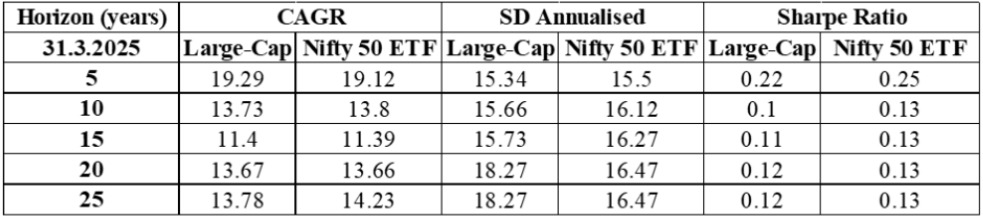
An analysis of fund returns over a 25 year period indicate that, over many time periods, large cap equity funds have outperformed the NIFTY 50 ETFs. Their volatility adjusted returns – measured by risk indicators like the Sharpe Ratio – match those of the NIFTY 50 ETFs.

Horizon (years)CAGRSD AnnualisedSharpe Ratio
31.3.2025Large-CapNifty 50 ETFLarge-CapNifty 50 ETFLarge-CapNifty 50 ETF
519.2919.1215.3415.50.220.25
1013.7313.815.6616.120.10.13
1511.411.3915.7316.270.110.13
2013.6713.6618.2716.470.120.13
2513.7818.2716.4715.50.120.13

Managers of active funds have the ability to avoid index laggards, allocate tactically to outperforming sector and exercise judgement during periods of market stress. In theory, therefore, given their track record and the promise to deliver alpha, should not investors prefer active funds? Yet the fund flows tell a different story.

There are several structural and behavioral factors that explain why retail investor tilt towards ETFs and Index Funds. Firstly, retail investors find it difficult to identify which active fund manager will deliver alpha in the future. While some active large cap funds have outperformed their benchmark over the last 25 years, the consistency of such outperformance is not uniform and they have had periods of underperformance. Passive funds, in contrast, almost guarantee market matching returns without the uncertainty. In times of market volatility, retail investors become wary of “manager risk” – the risk that a chosen fund manager may underperform. Passive investing eliminates this layer of decision making.

Secondly, ETFs and Index Funds have some structural advantages. As ETFs trade like stocks, they offer inter-day liquidity. They offer complete transparency of holdings, as they mirror the underlying index, thus easing portfolio construction for asset allocators. Younger investors are less emotionally attached to the idea of star fund managers and more focused on efficient exposure to asset classes. For investment advisors, recommending ETFs or Index Funds, simplifies client communication and portfolio monitoring.

Thirdly, passive funds have a clear cost advantage. Expense ratios of ETFs and Index Funds are significantly lower than those of actively managed funds. Even if active fund managers outperform their passive counterparts by 200 basis points, their higher fees can erode their net advantage. Over long periods, compounding of this fee difference can tilt the scales in favor of passive funds. For instance, as can be seen the table above, actively managed large cap funds have, on average for a 25-year period, delivered a CAGR of 13.78% compared to the CAGR of 14.23% delivered by the NIFTY 50 ETFs. This would mean that Rs.10,000 invested in a NIFTY 50 ETF in the year 2000 would now be worth Rs.2.78 lakhs whereas Rs.10,000 invested in a large cap fund would be worth only Rs.2.52 lakhs. For a new generation of investors, who prefer predictability, simplicity, transparency and lower costs, investing in passive funds aligns with their financial philosophy.

Author: Mr. Sashi Krishnan, Director – NISM

© 2026 National Institute of Securities Markets (NISM). All rights reserved.