
Notifications 6
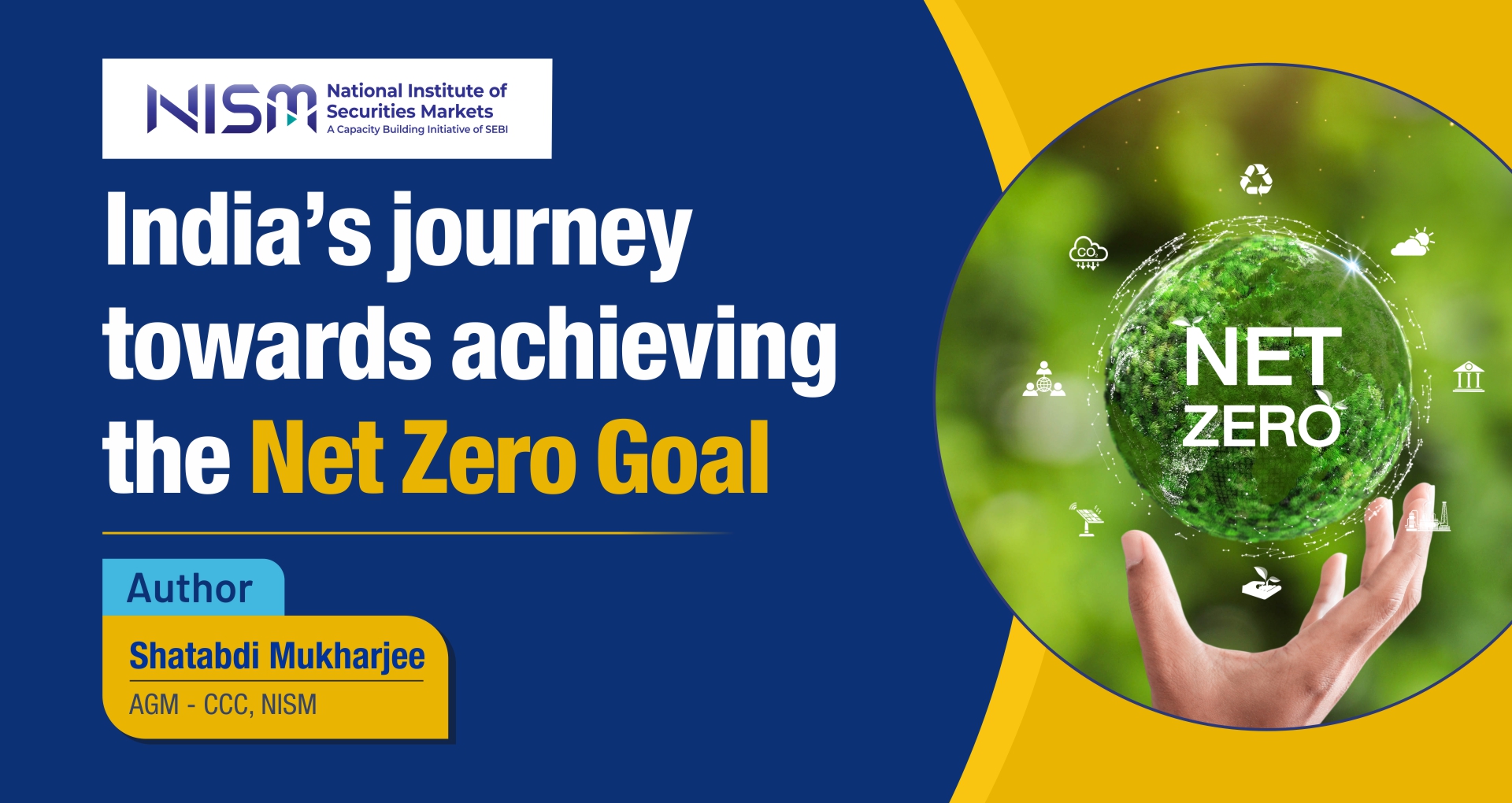
In the Paris Agreement at the Conference of Parties (COP-21), the world discussed the worsening effects of climate change, global warming and green-house gas (GHG) emissions on our planet and ways to limit these ill effects. Further, during COP-26 and COP-27, nations worldwide, including India, concurred to the idea that conscious efforts are required to curb these ill effects of global warming to sustain a better future. India, therefore, has committed to achieve the Net Zero goal by 2070.
Net Zero refers to the state where the effects of GHG emissions will be nil on the environment and society. In simpler terms, the amount of GHG produced should be equal to the amount of GHG removed from environment to reach to a net zero emission state. Currently, India is on track to becoming the 3rd largest economy in the world by 2030 with a projected GDP of USD7.3 trillion. [1] This growth story inevitably requires capacity expansion in all possible sectors viz. manufacturing, services, agriculture etc. It is pertinent to understand that capacity expansion involves setting up of manufacturing units, usage of natural resources to produce energy, involvement of technological automations etc. – all bearing a cost on the environment, whereas, achieving reduction goal of GHG emissions contrasts with these growth inducing activities. Thus, to have a conducive situation in both these areas, collaborative efforts from Government, Corporates and Investors are required.
The Government of India has taken efforts to introduce policies, based on best practices around the globe, that facilitates in reduction of effects of global warming thereby timely achieving the net zero goal. Several green projects are introduced by government and corporates alike, such as migrating towards cleaner energy, focusing on sustainable agriculture, adopting to the concept of circular economy etc., providing an impetus towards a sustainable earth.[2] The regulators of India deserve a special mention in innovating and regulating various products and markets that cater to this objective by providing clear investment guidelines, transparent disclosures and efficient reporting requirements.
Securities and Exchange Board of India (SEBI), the securities markets regulator, regulates various financial products that aid in financing/ re-financing of green projects/ assets. SEBI has also put in greater emphasis on disclosure and reporting by corporates involved in such sustainable activities. The robust Business Responsibility and Sustainability Reporting (BRSR) framework requires detailed disclosure of Environment, Social and Governance (ESG) performances of listed entities. Likewise, RBI, IRDAI, PFRDA and IFSCA has also issued circulars and guidelines to regulate their respective registered entities.
Investors, both individuals and institutions, have greater responsibility in channeling funds towards green projects enabling achievement of ESG objectives. In such a well-regulated environment, Indian investors have a plethora of financial products available to them that facilitate in achieving such sustainable environmental goals. Some of them are enumerated below, which are accessible to all investors, including retail investors, to direct their money to fund various ESG causes, more specifically climate-based causes:
Some of the thematic mutual funds are based on ESG objectives. These mutual funds invest their pooled money in equity shares of companies that aim to achieve a positive impact on the environment/ society/ corporate governance reducing long-term risks. These follow strategies such as Exclusionary i.e. avoiding harmful industries, Impact investing, Best-in class etc. to promote ethical investing thereby combating greenwashing.
Both Government and Corporates issue debt securities to raise capital to address ESG related concerns. It includes green debt securities, social bonds, sustainability bonds and sustainability-linked bonds that are issued in accordance with international frameworks to achieve positive sustainable outcomes and develop green infrastructures.[3]
help in financing the green projects. Green projects refer to the projects that aim to utilise the issue proceeds in producing sustainable outputs thereby reducing costs. Green projects include themes such as renewable and sustainable energy, climate change adaptation, sustainable waste management, pollution control etc. It also includes:
The participation by the issuers and investors on year-on-year basis is evidenced from the below statistics:
Given the fund requirement to achieve the net zero goal, India requires a cumulative investment of USD 22.7 trillion by 2070.[7] As per the Niti Aayog Report titled “Scenarios toward Viksit Bharat and Net Zero Financing Needs (Vol 9)” issued in 2026, Indian Capital Markets has an important role to play in mobilising around USD 16.2 trillion for the net zero transition.
CTA (Design creative section)-
In addition to these financial products, India has established the Indian Carbon Market Framework to reduce GHG emissions from the environment. The GHG emissions are priced through the trading of carbon credit certificates, issued by the Indian Government or any approved authority. The Carbon Credit Trading Scheme (CCTS) provides a detailed roadmap for the high GHG emitting industries (obligated and non-obligated entities), where the carbon credit certificates can be traded among registered entities to achieve decarbonization.[9] Thus, a dynamic CCTS market, regulated by Central Electricity Regulatory Commission, helps in managing the GHG emissions and also incentivises organisations to become energy efficient. With the detailed framework in place, the domestic CCTS market started its operations in four sectors.
These regulatory impetus, economic incentives, product innovations should couple with behavioural shift in Investors to achieve net zero objectives. As per the concept introduced by India at COP-26, Lifestyle for the Environment (LiFE), each individual/ organisation, globally, should engage in environment-friendly actions.[10] Small but consistent efforts such as usage of energy-efficient appliances, conservation of natural resources, banning the use of plastics, waste disposal management, planting of trees (afforestation), efficient usage of technologies etc. will result in reaching to an ideal low-carbon world.
Author: Shatabdi Mukharjee (AGM – CCC, NISM)
Net Zero Goal Meaning In the Paris Agreement at the Conference of Parties (COP-21), the world discussed the worsening effects…

Financial Literacy – Your Most Powerful (and Missing) Life Skill By 2035, Gen Z will have a 50% share in…

The Union Budget 2026, presented by Finance Minister Nirmala Sitharaman, marks a watershed moment in India’s economic narrative. Dubbed the…
© 2026 National Institute of Securities Markets (NISM). All rights reserved.
