
Notifications 9
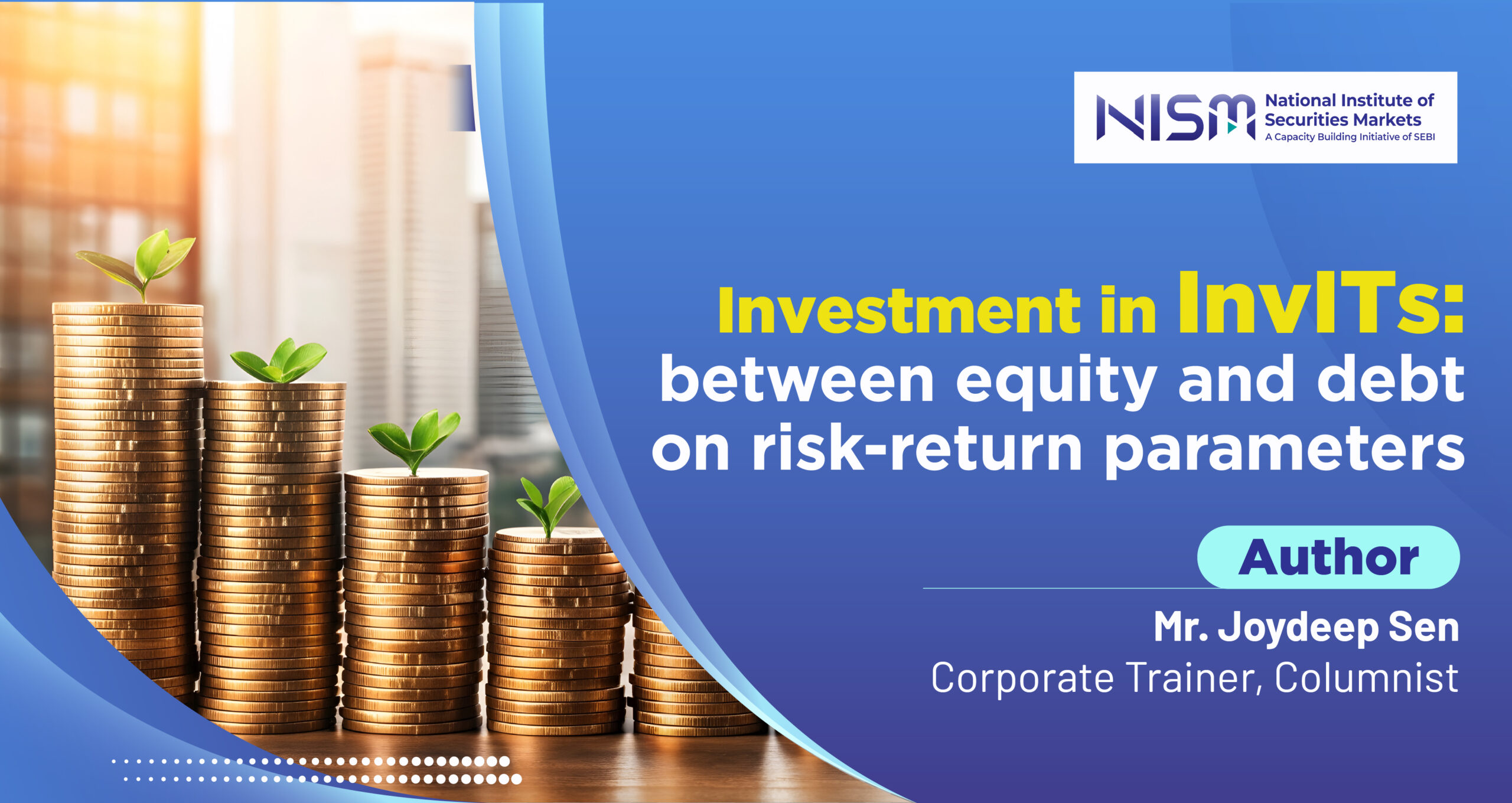
Retail investors can take exposure for a part of the portfolio, on better income visibility
Your investment portfolio comprises of various instruments, which are at different calibrations on the risk-return scale. As an example, we have hybrid funds, somewhere between equity (high risk – high return) and debt (low risk – low return).
Infrastructure Investment Trusts (InvITs) are investment vehicles similar to mutual funds that pool money from investors to invest in income-generating infrastructure projects like roads, highways, telecom towers, warehousing, digital infrastructure and power generation and transmission lines. Regulated by SEBI, they provide regular income (dividends/interest) and capital appreciation, requiring 90 percent of net cash flows to be distributed to investors. NSE defines “an Infrastructure Investment Trust (InvITs) is Collective Investment Scheme similar to a mutual fund, which enables direct investment of money from individual and institutional investors in infrastructure projects to earn a portion of the income as return”.
They help infrastructure developers monetize completed assets, reducing debt and freeing up capital for new projects. Comprised of a Sponsor, Trustee, Investment Manager and Project Manager, they hold assets directly or through Special Purpose Vehicles (SPVs). As an example, National Highways Authority of India (NHAI) constructs multiple roads; one road would be an SPV for this purpose. The toll collections from the road would be routed to the InvIT that is holding multiple SPVs originated by NHAI. While there is no commitment or guarantee on the toll collections, there is a visibility. This visibility comes from historic data of traffic on that road, expected GDP growth, expected traffic growth, toll rates, etc.
InvITs have certain aspects similar to equity and debt investments. The units are listed at the Exchange (NSE/BSE) and prices are open to fluctuations. On this aspect, it is similar to equity. However, equity is more volatile. In equity, the dividend yield is nearer to 1 percent, as market prices appreciate significantly. The handsome returns you earn in equity over a long holding period, say 12 to 20 percent, is driven largely by price appreciation. In bonds or debt investments, it is the reverse. Most of the returns come from the coupon or interest. On this aspect, InvITs are similar to debt investments, though there is no committed coupon.
In InvIT, the distribution yield is much higher than equity, say in double digits. Add a bit of price appreciation, and you are looking at returns similar to equity. The plus point here is, the high distribution yield provides a measure of certainty to your returns. For the sake of argument, even if you take price appreciation of InvIT as nil, you are still looking at decent returns by dint of distribution.
Expand your understanding of modern investment avenues with the NISM Alternative Investment Fund Fundamentals course. Ideal for finance professionals, students, and investors.
In any investment, your return is resale price or current market price over purchase price, plus the inflows in the interim. This principle is same for InvITs, but it is more nuanced. In an InvIT, money flows from the multiple SPVs or Holdco to the umbrella entity. This flow of money can be interest, dividend, repayment of capital and a bit of treasury income. The head of money flow will be mentioned in the statement accompanying the payout. The point is, it is not a mono-source like dividend in equity or interest in bonds.
To understand returns delivered till date, the investor has to look at the total picture. As an example, at the beginning of a financial year, the market price of an InvIT, which was issued at a price of Rs 100, was also Rs 100. At the end of the financial year, the market price of the InvIT went up to Rs 103. Over the course of the financial year, the InvIT distributed Rs 10 under various heads. Hence the earning for the investor for the year, is Rs 3 (price appreciation) plus Rs 10 (distribution). In place of market price, you may take the NAV, but the frequency of announcement is half-yearly. While NAV reflects the value of the assets owned by the InvIT, through the multiple SPVs, market price would reflect other data and outlook of market participants.
Gain deeper insights into Alternative Investment Funds with the NISM-Series-XIX-A: AIF Category I and II Distributors Certification Exam.
Allocation to InvITs in your portfolio can be a good diversification avenue. Apart from mild price appreciation, it provides a hedge against inflation. InvITs are relatively inflation-resilient because many underlying infrastructure assets, such as roads and transmission lines have tariff structures linked to inflation or periodic escalation clauses. Equity investments, over a long term, beats inflation but debt investments, in certain phases, underperform inflation. In InvITs, we have entities from multiple sectors e.g. roads, power, telecom, optical fibre, warehousing, etc. The high credit rating from the rating agencies gives another layer of comfort.
Note: This article was originally published in Mint on 1 May 2026.
Author: Joydeep Sen, a corporate trainer (financial markets)
Through the Lens of Circuit Breakers: Why does the Stock Market Hit Pause? Imagine this. Monday morning, June 23, 2025.…
Last Updated on: June 17, 2026 The Successful Default: When a Municipal Bond Serviced Investors but Failed Citizens Background: Understanding…
Last Updated on: June 1, 2026 What is SIF? Benefits, 7 Months Progress & Investment Considerations Progress review gives us…
© 2026 National Institute of Securities Markets (NISM). All rights reserved.
