
Notifications 7
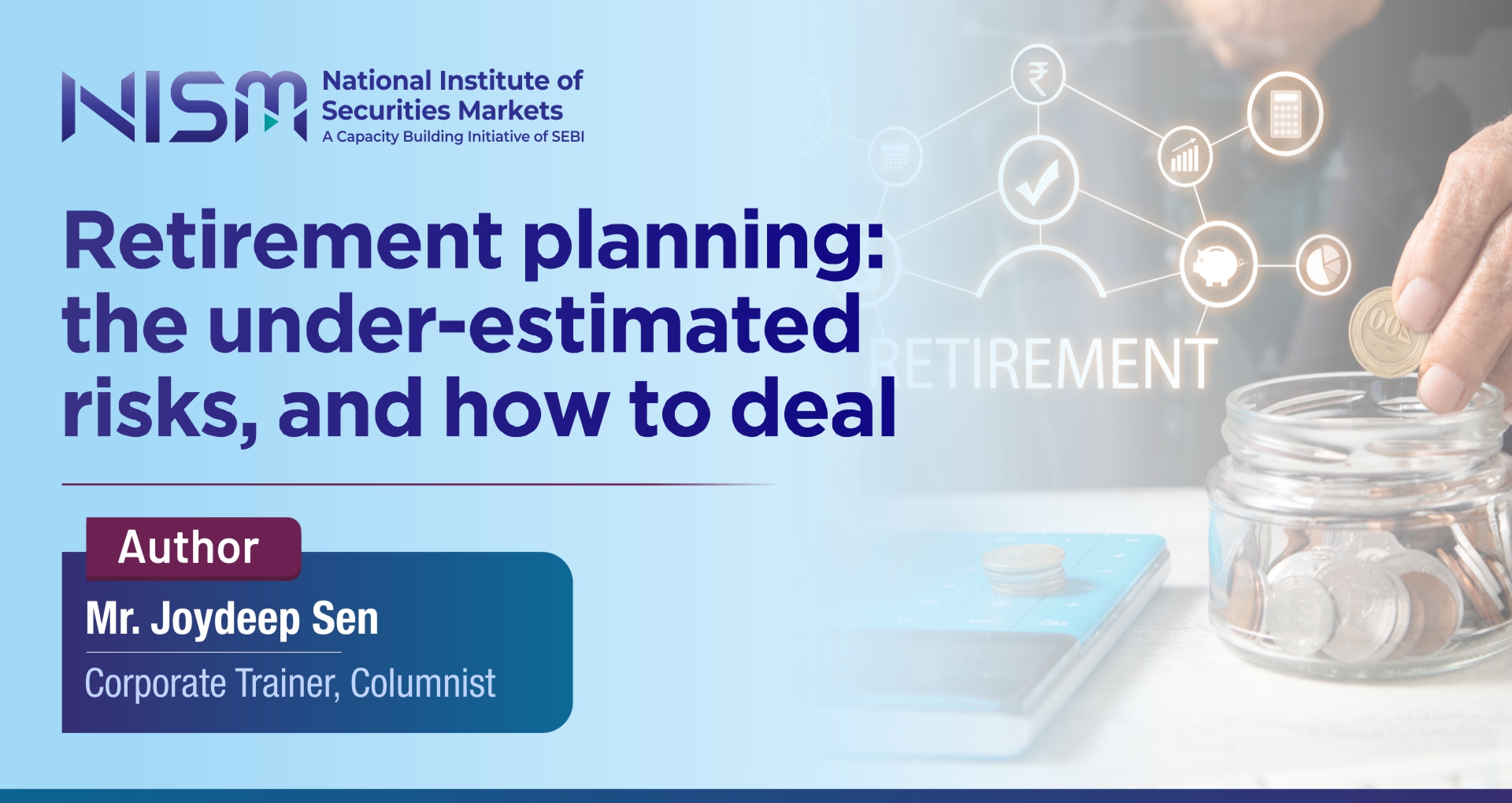
Volatility risk is well known, but that is usually less dangerous
Retirees fear market volatility, and volatility is a risk flagged by financial planners, provided you are taking professional inputs. However, volatility risk is not as dangerous – we will discuss why. The bigger risks are (a) Sequence-of-returns risk (a potent one) (b) Longevity risk (living too long) and (c) Inflation risk (the silent destroyer). We will also look at how to address these risks.
Volatility risk
Returns from market-based investments are not like a bank deposit, it does not move in a straight line. When you are checking your portfolio report, one fine morning, your returns may look much lower than when you last checked it. In this context, equity is a high-risk asset i.e. volatility is relatively higher. Fixed income or debt is relatively less risky, as returns are more stable than equity. It is advisable that retirees do a proper balance between equity and debt in the investment portfolio, and this approach is well known. We mentioned earlier, volatility risk is not as dangerous. The reason is, market moves in cycles. Down cycles recover over a period of time – the time period for recovery would be different. Volatility risk can be managed through allocation to various investment assets i.e. equity, debt, gold, etc.
Sequence risk
Sequence risk, also known as sequence of returns risk, is the danger that experiencing poor investment returns in the early years of retirement, combined with ongoing portfolio withdrawals for living expenses, will significantly increase the chance of running out of money prematurely. This risk is particularly impactful during the first five to ten years of retirement because withdrawals may lead to sale of assets at lower-than-principal prices (i.e. at a loss), permanently reducing the principal available to benefit from potential future market recoveries.
In the accumulation phase (working years), market downturns can be an opportunity to buy assets at lower prices (rupee-cost averaging). In retirement, the dynamic reverses; withdrawals during a bear market leads to “rupee-cost ravaging,” where more shares are sold to meet the required cash flow, making it difficult for the portfolio to recover. Two retirees with the same starting portfolio and the same average annual return over 30 years can have vastly different outcomes based purely on the order in which those returns occur. The one who experiences losses in the first five years is at a much higher risk of portfolio depletion and may run out of money. To put in perspective, volatility hurts investors emotionally; sequence risk hurts retirees mathematically.
How to deal with sequencing risk? Build a cash reserve/bucket strategy: Set aside one to three years’ worth of living expenses in safe, liquid assets like Bank Deposits or Liquid Funds. This buffer allows you to cover expenses during market downturns without selling investments at a loss, giving the portfolio time to recover. We mentioned portfolio allocation earlier; you have to take care of this in the consolidation phase, which is towards the end of your accumulation phase (working years), before retirement. Consolidation implies having a proper balance between equity, debt and gold (in financial form). When one asset market is not doing well, say equity or debt or gold, you can withdraw from the other.
Longevity risk
A retired person may have an approach “I don’t want to die with unused money.” If your children are well settled and earning well, you need not leave a legacy from your hard-earned money. However, longevity risk is outliving your capital i.e. savings kitty. Longevity risk is growing because of (a) rising life expectancy (b) better healthcare and (c) your spouse may live longer.
How to deal with longevity risk? When you are planning for the golden phase of your life – while doing the excel calculations – put a number higher than you are likely to live. You’re not planning for an extreme outcome – you’re planning for a statistically likely one. Having said that, doing that excel on financial planning is not as easy as everyone’s job, it is more of a professional job. This is another pointer that you require professional inputs for your financial planning.
Inflation risk
Why retirees underestimate inflation risk? Inflation feels low year-to-year – it is measured as how much prices went up over one year, but compounds brutally over decades. Medical inflation often exceeds headline consumer inflation (CPI). Fixed pensions lose relevance over time due to inflation. For a perspective, if inflation rate is say 5 percent per year, purchasing power will halve in approx. 14 years. The calculation is simple: divide 72 by the inflation number you have in mind.
How to deal with it? Need not over-prepare, this is inevitable. The usual solution given by financial planners is that equity returns beat inflation over a long time frame and bank deposits (particularly net of taxation) does not beat inflation. This is correct. However, your allocation to equity, debt, gold etc should be appropriate as per your risk appetite and objectives.
What should retirees do?
You may take care of these aspects in your retirement planning:
Conclusion
Most retirees obsess over market volatility because it is visible and immediate. The risks that actually break retirement plans operate quietly – poor timing of returns, living longer than expected, and steadily rising costs. By the time these risks become visible, it is often too late to fix them. The guidance discussed above may help.
Article originally published in The Hindu
Author: Mr. Joydeep Sen, Corporate Trainer, Columnist

Net Zero Goal Meaning In the Paris Agreement at the Conference of Parties (COP-21), the world discussed the worsening effects…
Financial Literacy – Your Most Powerful (and Missing) Life Skill By 2035, Gen Z will have a 50% share in…

The Union Budget 2026, presented by Finance Minister Nirmala Sitharaman, marks a watershed moment in India’s economic narrative. Dubbed the…
© 2026 National Institute of Securities Markets (NISM). All rights reserved.
