
Notifications 9
There is an old Yiddish proverb that says “Man Plans, God laughs”. This proverb beautifully sums up the dilemmas we face when we plan for retirement. As William Sharpe, the Nobel Laureate, famously said – “retirement is the nastiest, hardest, problem in finance”. Simply because there are multiple layers of uncertainty around inflation, life expectancy, investment returns and lifestyle choices, the problem is strictly not solvable. There will always be risks you cannot eliminate. There will always be circumstances you cannot anticipate.
Inflation is the biggest unknown. It is next to impossible to estimate the amount of income you will need during retirement because inflation will erode your purchasing power over time. For example, if we assume that long term inflation is 4%, the amount of money you need to spend to maintain your standard of living will double every 18 years. So, if you retire at 60 and are spending Rs.10 lakhs per annum, by the time you are 78 you will need Rs.20 lakhs and by the time you are 96 you will need Rs.30 lakhs. However, if you assume an inflation rate of 6% instead of 4%, you will need Rs.30 lakhs by the time you are 84, a full 12 years earlier! The best option, therefore, is to assume a higher rate of inflation in your calculations. The next big problem is on making assumptions on how long you will live. For India, the Life Tables indicate that the average remaining life expectancy at 60 is 17.5 years for men and
19.2 years for women – an average of 18.3 years for Indians. But this does not make any sense for an individual because you cannot be 50% dead at 78 – you are either dead or alive! Your individual lifespan has no statistical validity. The sensible assumption would be to plan for a 100 -year life.
The investment return question is also a complex one. The answer derives from your asset allocation choices. The danger in investing for the long term in fixed income is that you sacrifice the ability to preserve purchasing power because your portfolio returns may not be able to keep up with inflation. On the other hand, if your portfolio is overweight equity, you risk losing your principle. This require you to do a fine balancing act of not being overweight fixed income and having a reasonable exposure to equity at all times.
Your lifestyle choices will determine how long into retirement your money will last. Spending is normally higher in the early active retirement years, lower mid-retirement and then increases again mainly because of healthcare costs. The assumption you make should not be just a multiple of your spending but must be determined by your understanding of what you need to lead a more fulfilling life.
Hopefully, this approach will make the retirement problem a little less nasty!
Author: Mr. Shashi Krishnan, Director – NISM
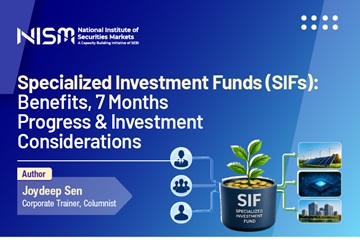
Last Updated on: June 1, 2026 What is SIF? Benefits, 7 Months Progress & Investment Considerations Progress review gives us…

Last Updated on: May 29, 2026 The “Melody” Incident: A Case of various Behavioural Bias in Indian Markets Modern finance…

Last Updated on: May 21, 2026 How to Make an Investment Portfolio for Long-Term Wealth Creation In the world of…
© 2026 National Institute of Securities Markets (NISM). All rights reserved.
